
Atmospheric O₂ reveals a strengthening ocean carbon sink and a stagnant net land sink since 1990
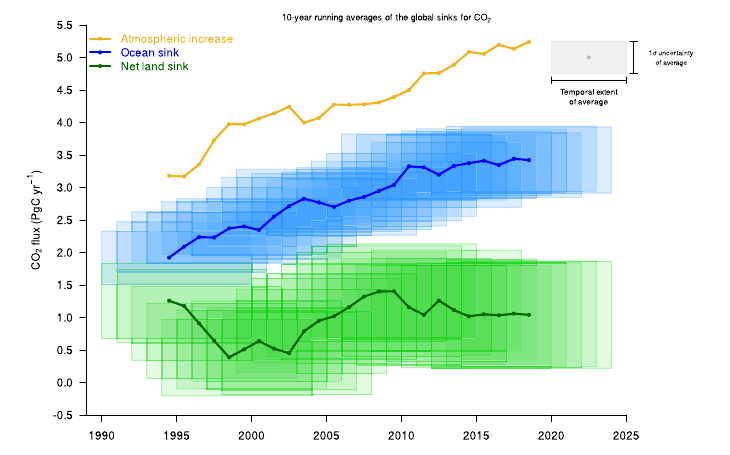
Figure 1 from Morgan et al. (2026), Science: Ten-year running means of the global ocean and net land carbon sinks and atmospheric CO₂ increase.
The paper Atmospheric O2 reveals a strengthening ocean carbon sink and a stagnant net land sink since 1990, led by Eric Morgan (Research Scientist) and co-authored by Yuming Jin (Postdoctoral Scholar) and Ralph Keeling (Co-Lead PI), has been published in Science. Using more than 30 years of atmospheric oxygen and carbon dioxide measurements, the study estimates how ocean and land carbon uptake have changed since 1990. The results show that the ocean carbon sink has strengthened, while the net land carbon sink has shown no significant long-term growth despite substantial variability. These findings highlight the importance of long-term atmospheric observations for understanding and modeling the global carbon cycle.
An accompanying Science Perspective, “Oxygen tells the tale of Earth’s carbon sinks” , discusses how atmospheric oxygen observations help distinguish ocean and land carbon uptake. It also highlights the value of these results for evaluating carbon cycle models and reassessing the global carbon budget.
Read more in the Scripps Institution of Oceanography press release .


